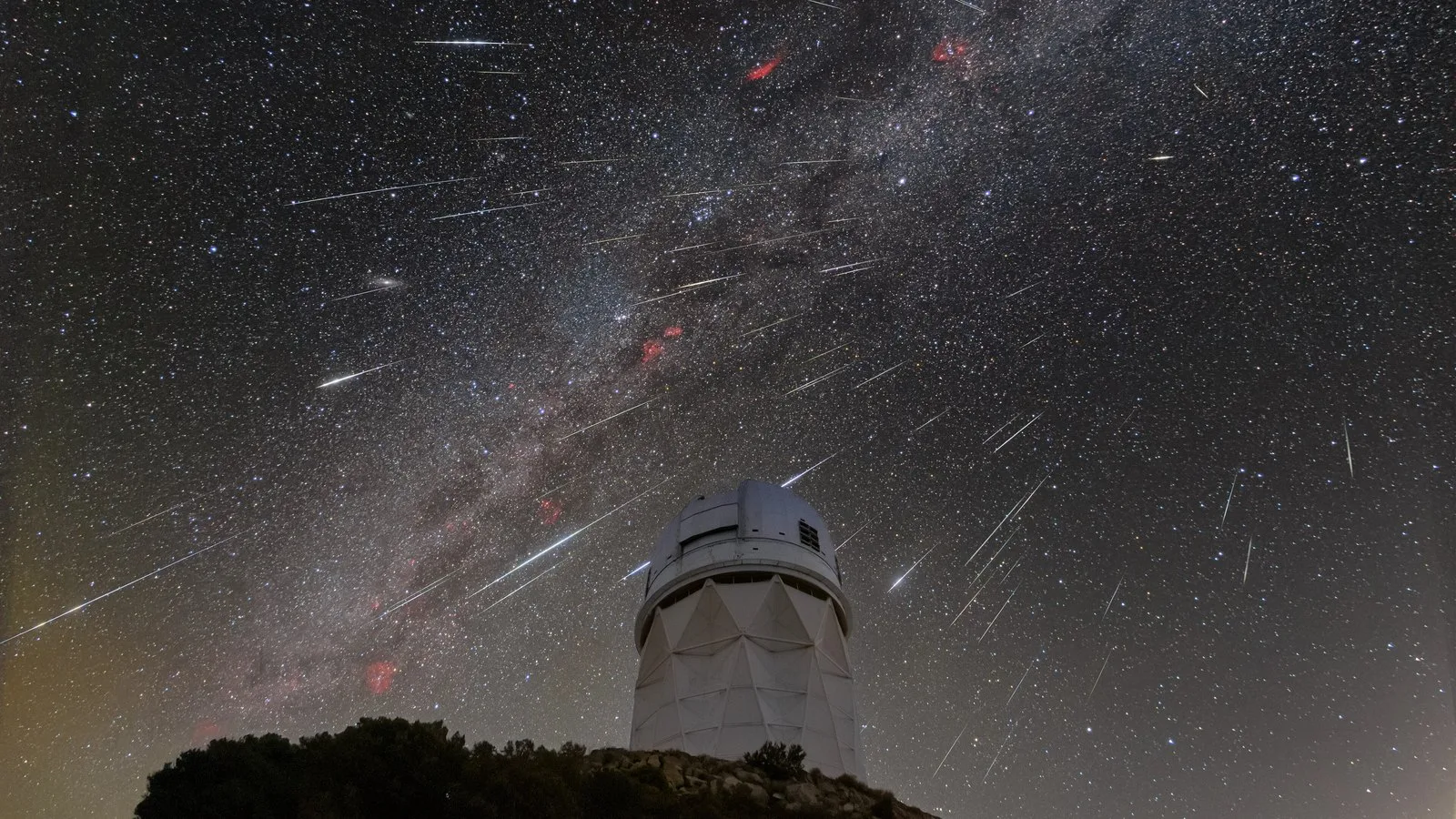
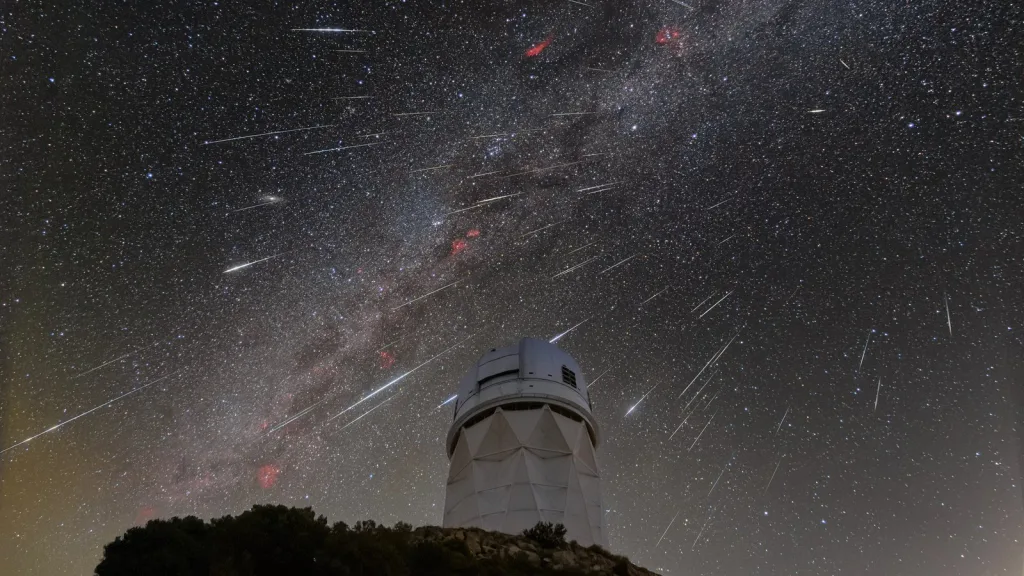
The best meteor shower of the year gets a dark sky in 2026. The Geminids peak on the night of Dec. 13 into Dec. 14, and the American Meteor Society’s shower calendar puts the Moon at just 15% illuminated that night, a thin waxing crescent that sets in the evening. The society calls the lunar conditions “generally favorable.”
That matters more than it sounds. The AMS warns that moonlight can hide fainter meteors while the Moon is above the horizon, and most meteors are faint. In 2026 the timing works in viewers’ favor.
What to expect
NASA’s Geminids fact page lists the shower as active from Dec. 4 to Dec. 17 and says observers under dark skies can expect 40 to 50 meteors an hour at the peak. Under perfect conditions, the agency says, the count can reach 120 an hour. The meteors hit the atmosphere at about 22 miles per second, slower than many showers, and NASA says they tend to be bright and yellow.
The Geminids are also unusually friendly to people who don’t want to stay up until 3 a.m. Most meteor showers are best in the hours before dawn. The AMS notes that the Geminids are the one major shower with good activity before midnight, because the constellation Gemini, where the meteors appear to originate, is well placed from about 10 p.m. on. NASA describes them as one of the best showers for young viewers for the same reason.
A shower from a rock, not a comet
Most meteor showers come from comets, which shed dust each time they swing past the Sun. The Geminids come from 3200 Phaethon, an object about 3.2 miles across that looks like an asteroid but behaves in some ways like a comet. NASA says Phaethon takes 1.4 years to orbit the Sun and travels on a stretched, comet-like path that brings it unusually close to the Sun. It doesn’t grow a tail, and its light looks like a rocky asteroid’s, but the debris it leaves behind is what Earth plows through every December.
Astronomers have floated two labels for it: a “dead comet” that has lost its ice, or a “rock comet,” which NASA calls a new kind of object astronomers are discussing. NASA says scientists still aren’t certain how to classify it. The Geminid particles are also several times denser than typical comet dust, according to the agency.
Phaethon itself was found on Oct. 11, 1983, by the Infrared Astronomical Satellite, and astronomer Fred Whipple was the one who connected it to the Geminids. The shower is younger than you might expect. NASA says it first appeared in the mid-1800s, when observers counted only 10 to 20 meteors an hour, and it has strengthened since.
How to watch
NASA’s advice is simple. Get away from city and street lights, dress for winter, lie on your back with your feet facing south, and give your eyes about 30 minutes to adjust to the dark. There is no need to stare at Gemini itself; meteors can show up anywhere in the sky. No telescope or binoculars are needed, and they would only narrow your view.
If clouds roll in on the 13th, the night before and the night after are also worth a look, since NASA describes the maximum as broad. The shower stays active until Dec. 17.
December has a second, smaller shower. The Ursids peak Dec. 21 into Dec. 22, and the AMS says observers usually see only 5 to 10 an hour, this year under a Moon that will be 89% lit. The Geminids are the one to plan for.
For more on the sky, see our piece on where and when to see the next solar eclipses, or read about why leaves change color in the fall. More science coverage is on our Science & Nature page.