Put a North American porcupine next to an African crested porcupine and you would assume they are close relatives. Both are rodents, both are covered in quills, both waddle. But they belong to different families, and biologists treat the resemblance as two lineages arriving at the same answer: if you are slow and edible, grow spikes.
Two families, one idea
Old World porcupines, family Hystricidae, live across Africa, southern Europe and Asia. New World porcupines, family Erethizontidae, live in the Americas, from Canada down into South America. The New World group’s closest relatives are other South American rodents, the group that includes guinea pigs and chinchillas. The two porcupine families have been on separate tracks for tens of millions of years.
The quills are different tools
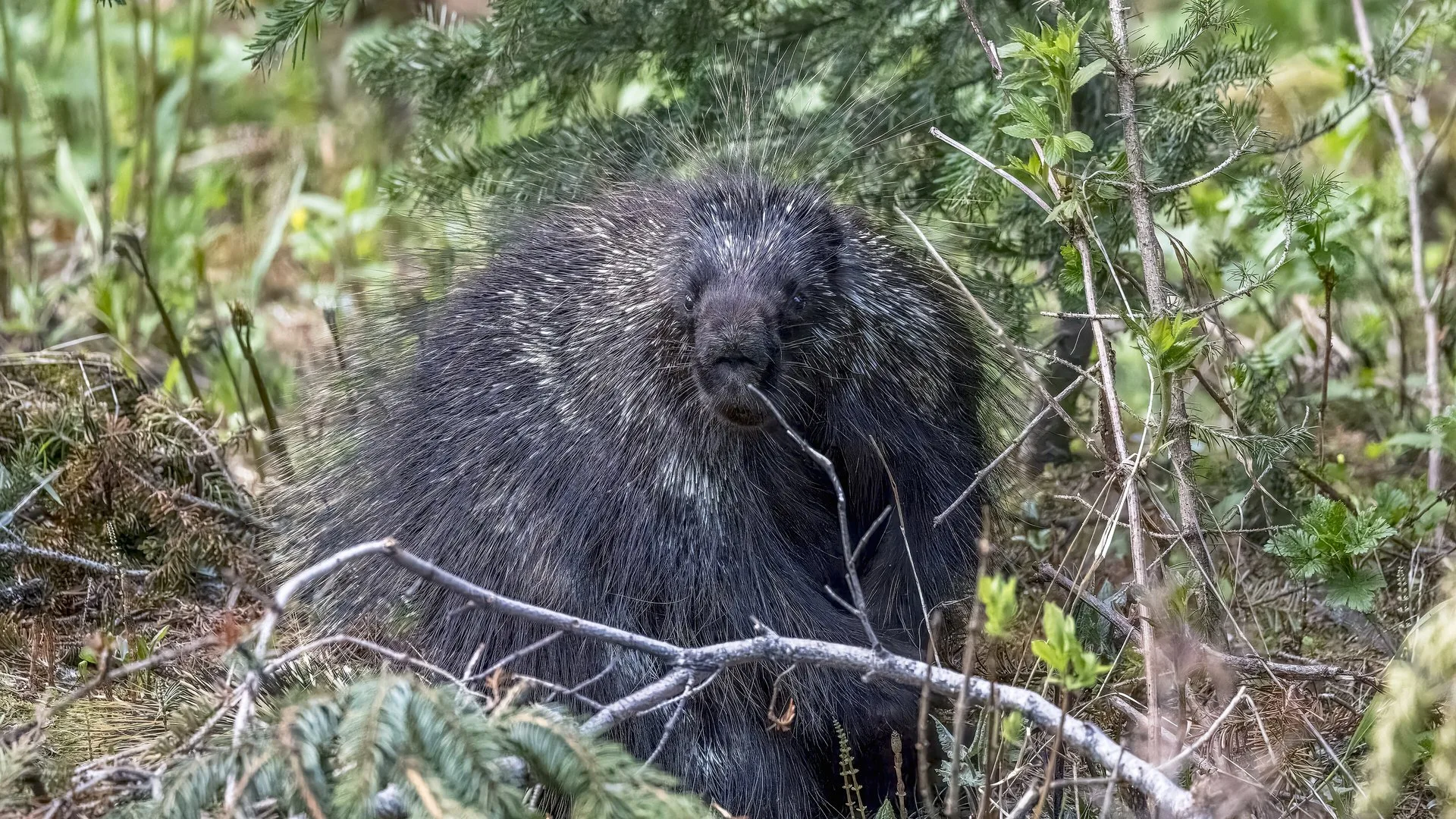
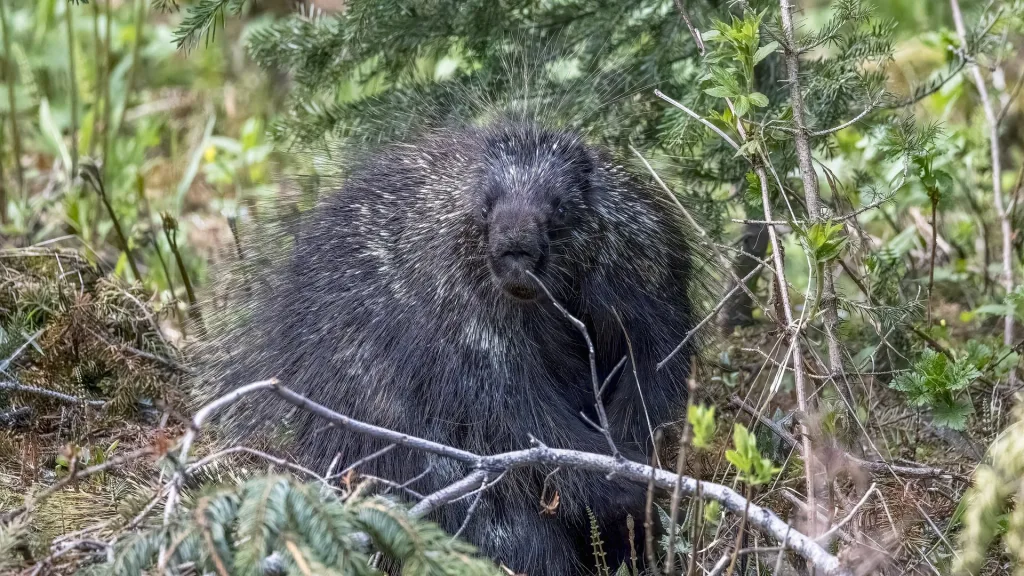
The North American porcupine, Erethizon dorsatum, carries around 30,000 quills, most of them two to four inches long. Each is tipped with tiny backward-facing barbs. A 2012 study in the Proceedings of the National Academy of Sciences found that the barbs help the quill slide in and make it much harder to pull back out, which is why a dog that tangles with one usually ends up at the vet.
The African crested porcupine, Hystrix cristata, goes for length instead. Its longest quills can reach a foot or more, banded black and white, and lie along its back and sides like a striped cape. They are stiff and sharp rather than barbed. On its tail it carries short, hollow, open-ended quills that rattle when it shakes them, a warning that works in the dark.
Neither one can shoot them
Cartoons are to blame for this one. No porcupine can fire its quills. They come loose easily, so an animal that bites or swats one ends up wearing a few. The crested porcupine adds a move of its own: it raises its quills, rattles its tail, stamps, and then runs backward or sideways into the attacker. Lions and leopards have been found with quills stuck in their faces and paws.
Trees versus burrows
The North American porcupine is a climber. It spends much of its time up in trees, eating bark, buds and needles in winter and green plants in summer. It is brownish to grayish, about the size of a small dog, and usually weighs somewhere around 15 to 25 pounds.
The crested porcupine stays on the ground. It is one of the largest rodents in Africa, often 30 pounds or more, and lives in burrows or rocky shelters, coming out at night to dig for roots, bulbs and fallen fruit.
Who wins?
The schoolyard question has a fair answer. In a straight fight, the African crested porcupine has the size, the longer quills and the charge-backward technique. The North American porcupine’s barbs are nastier to deal with afterward, and its tree-climbing keeps it out of most fights to begin with.
Sources: Cho et al., “Structural mechanism for facile tissue penetration and difficult removal by porcupine quills,” PNAS (2012); North American porcupine and Crested porcupine, Wikipedia; Erethizon dorsatum, Animal Diversity Web.