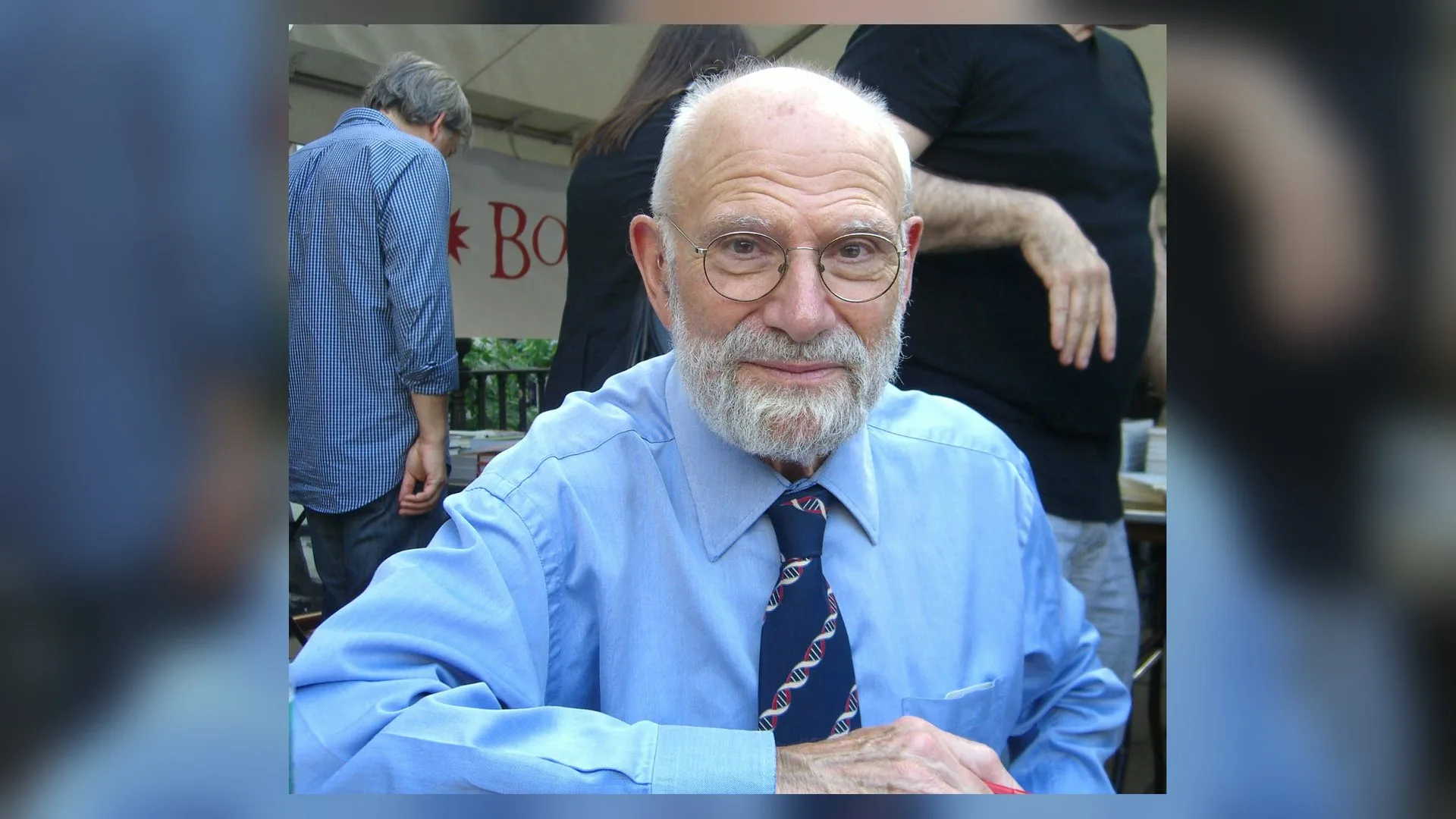
Oliver Sacks spent his working life with people whose brains did unusual things: a man who mistook his wife for a hat, patients frozen for decades by sleeping sickness, a surgeon with Tourette’s syndrome, an artist who lost his color vision. In a series of books written between the 1970s and his death in 2015, he turned their stories into literature, and changed how millions of readers thought about the mind.
From London to the Bronx
Sacks was born in London in 1933 to a family of doctors and trained in medicine at Oxford before moving to the United States in the early 1960s. In 1966 he began working at Beth Abraham Hospital in the Bronx, where he met a group of patients who had survived the encephalitis lethargica epidemic of the 1910s and ’20s and had been left motionless for decades. When he gave them the new drug L-dopa in 1969, some “awakened,” dramatically but often only briefly. His 1973 book about them, Awakenings, was later made into a 1990 film starring Robin Williams and Robert De Niro.
The case history as literature
Sacks’s great gift was to treat a case history as a life story. The Man Who Mistook His Wife for a Hat (1985) made him famous. An Anthropologist on Mars (1995) introduced many readers to Temple Grandin. Musicophilia (2007) explored how music lives in the brain. Rather than describing patients only by their deficits, he asked how they adapted, what they could still do and what their experience revealed about everyone’s brain.
Some critics accused him of turning patients into curiosities. Sacks took the concern seriously, and his later work is notable for how much it lets his subjects speak for themselves.
Writing about himself
Late in life, Sacks turned the same attention on himself. His memoir On the Move (2015) was frank about his youth, his drug use in the 1960s and his long solitude, and about finding love late in life with the writer Bill Hayes. In February 2015, after learning his cancer had spread, he wrote an essay in The New York Times called “My Own Life,” which reflected on dying with gratitude rather than fear. It was shared millions of times.
He died in New York in August 2015, at 82. His books remain in print and in classrooms, still teaching the lesson that runs through all of them: to understand a person, listen to their story.
Sources: Oliver Sacks, “My Own Life,” The New York Times; The Oliver Sacks Foundation; Oliver Sacks, Wikipedia.