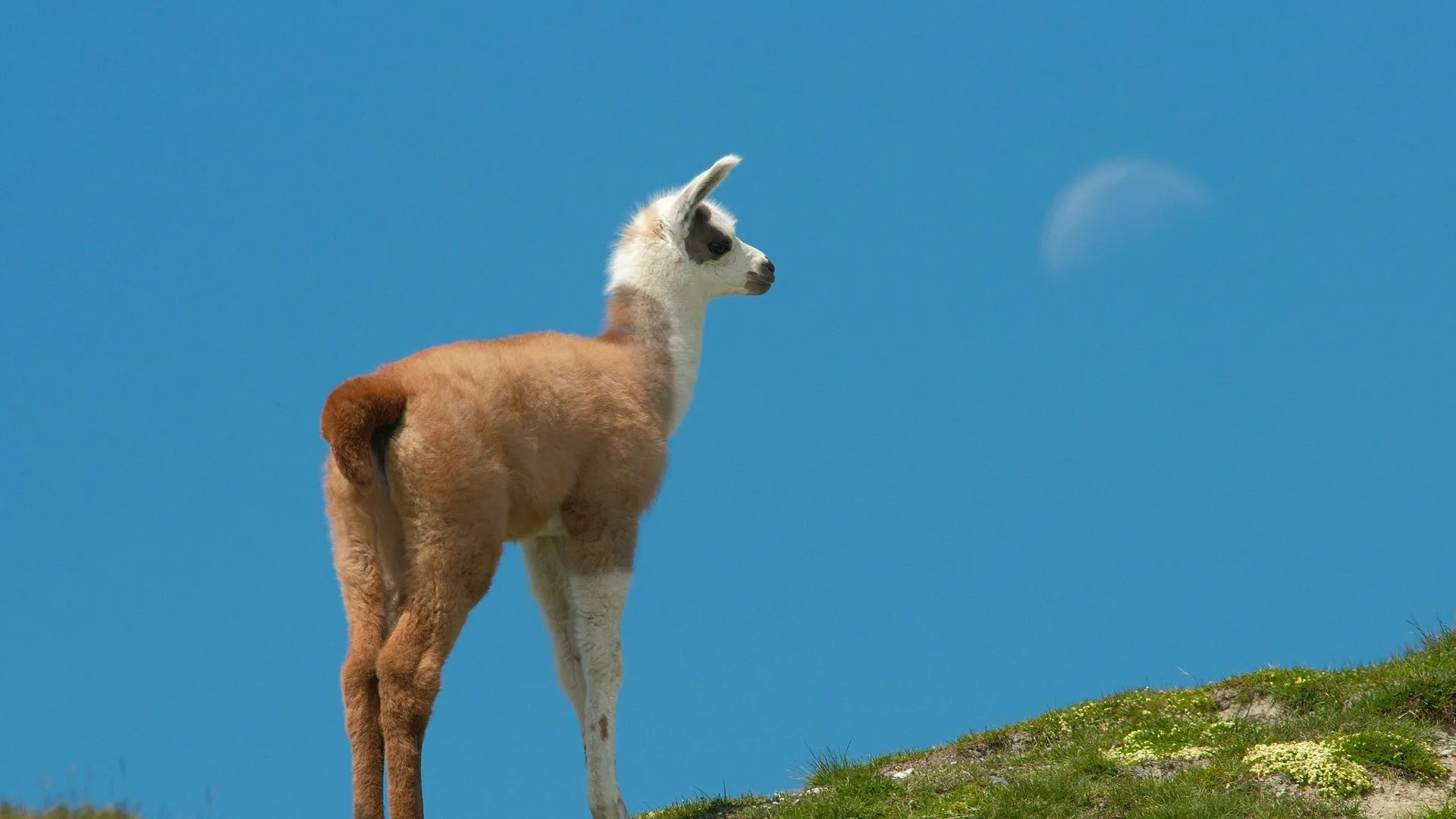

A llama and a camel do not look much alike at first. One is a woolly, long-necked animal of the Andes, the other a humped desert animal of Africa and Asia. But they belong to the same family, Camelidae, and once you know that, the resemblances start jumping out: the split upper lip, the long neck, the padded two-toed feet, the cud-chewing, and the famous willingness to spit.
The family tree
There are four South American camelids. Two are wild: the guanaco and the smaller, finer-wooled vicuña. Two are domestic: the llama, bred from the guanaco, and the alpaca, bred from the vicuña. Andean peoples domesticated them thousands of years ago, and they became central to life in the high mountains, giving wool, meat, dung for fuel and, in the llama’s case, a pack animal that could work at altitude.
On the other side of the world are the true camels: the one-humped dromedary, the two-humped Bactrian and the critically endangered wild Bactrian camel.
It started in North America
The surprising part is where the family began. Camelids evolved in North America roughly 40 to 45 million years ago, and for most of their history that is where they lived. Some lineages crossed the Bering land bridge into Asia and gave rise to the camels. Others moved into South America once the Isthmus of Panama formed. The camelids that stayed behind died out near the end of the last Ice Age. Fossil camels have turned up at the La Brea Tar Pits in Los Angeles and, remarkably, on Ellesmere Island in the Canadian high Arctic.
Working animals
Llamas are still used as pack animals, though they carry less than people expect. A fit adult is usually loaded with about a quarter of its body weight, and a llama that thinks the load is too heavy will lie down and refuse to move. Alpacas are smaller and kept almost entirely for their fiber.
In the United States, llamas have picked up another job: guarding sheep and goats. A single gelded llama placed with a flock will often confront coyotes and stray dogs, and plenty of ranchers swear by them.
About the spitting
Llamas spit, like camels, and what comes out is a mix of saliva and stomach contents. Most of the time they spit at each other, over food or rank in the herd. A normally raised llama rarely spits at people. The ones that do were often over-handled as babies and came to treat humans as just another llama, which tends to end badly for everyone.
For the camel side of the family, see our guide to one-hump and two-hump camels.
Sources: Camelid and Llama, Wikipedia; Llama, Encyclopaedia Britannica.