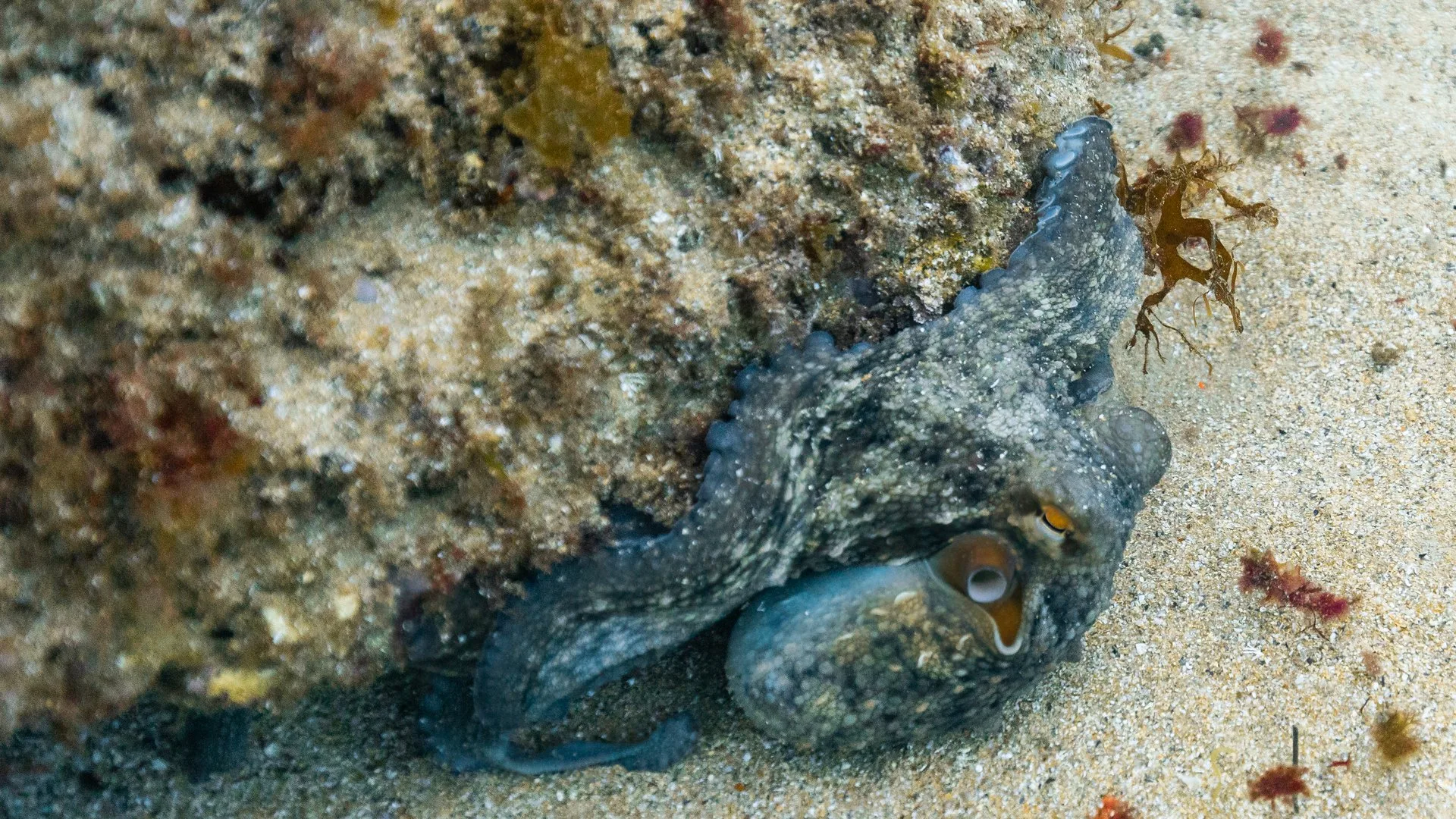
An octopus has about 500 million neurons, roughly as many as a dog. What makes it strange is where they are. About two-thirds sit not in its brain but in its eight arms, each of which can taste, touch and react on its own. Scientists sometimes describe the octopus as having a central brain plus a semi-independent nervous system in every limb.
Escape artists
Octopuses are famous for solving problems. In labs and aquariums, they have learned to open screw-top jars, navigate mazes and recognize individual people, sometimes squirting water at keepers they dislike. In 2016, an octopus named Inky escaped from his tank at New Zealand’s National Aquarium, slid across the floor and disappeared down a drainpipe to the sea. In the wild, some carry coconut shells to use as portable shelters, a behavior that researchers described as tool use.
A different path to intelligence
What fascinates scientists is that octopuses evolved intelligence entirely separately from us. Our last common ancestor was a simple wormlike creature more than 500 million years ago. Mammals, birds and octopuses all developed complex minds independently. The philosopher Peter Godfrey-Smith, in his book Other Minds, calls the octopus the closest we will come to meeting an intelligent alien.
Short lives
The puzzle is why such a clever animal lives so briefly. Most octopuses live only one or two years and die soon after breeding. Unlike social animals, they do not learn from parents or pass knowledge to offspring. Every octopus works out the world largely from scratch.
Feeling pain
Growing evidence that octopuses can feel pain has changed the law. A 2021 review for the British government found strong evidence of sentience in cephalopods, and the UK now protects them under animal welfare law. Plans for commercial octopus farming, including a proposed farm in Spain, have drawn fierce opposition from scientists and animal welfare groups, and some U.S. states have banned the practice. The more we learn about octopuses, the harder it is to treat them as just seafood.
Sources: Octopuses, squids and relatives, Smithsonian Ocean; Review of the Evidence of Sentience in Cephalopod Molluscs and Decapod Crustaceans, London School of Economics (for the UK government); Octopus, Wikipedia.