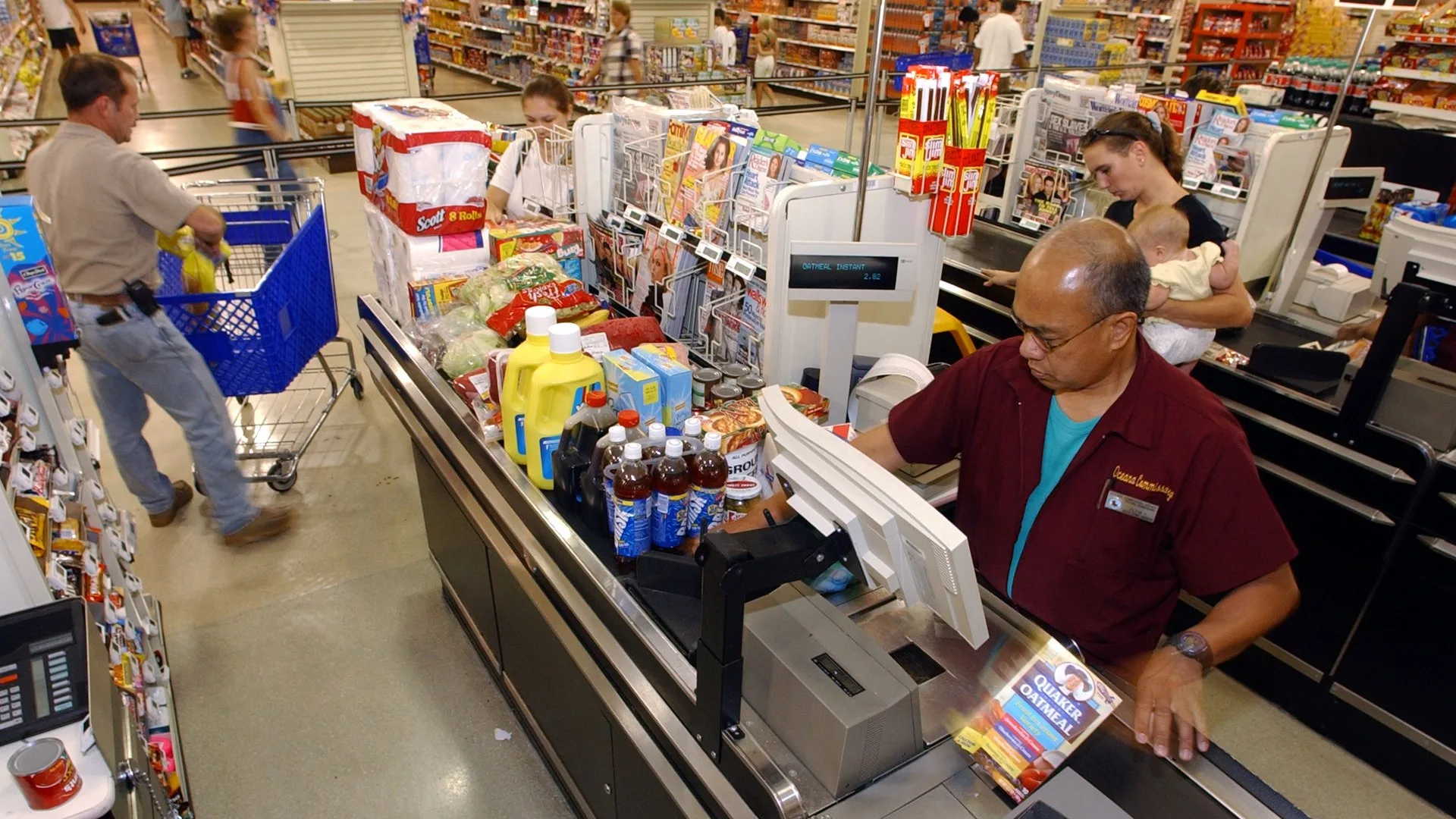
At 8:01 a.m. on June 26, 1974, at a Marsh supermarket in Troy, Ohio, a cashier named Sharon Buchanan passed a 10-pack of Wrigley’s Juicy Fruit gum over a scanner. It rang up 67 cents. It was the first retail scan of a product with a Universal Product Code, the barcode that now appears on almost everything we buy. The pack of gum is in the collection of the Smithsonian’s National Museum of American History.
An idea drawn in the sand
The barcode began decades earlier. In 1948, Norman Joseph Woodland, a graduate student, was trying to solve a supermarket’s request for a way to capture product information automatically. Sitting on a Miami beach, he drew dots and dashes in the sand like Morse code, then pulled them downward into lines. He and Bernard Silver patented a circular “bullseye” barcode in 1952. The technology to read it cheaply, lasers and computers, did not exist yet.
Agreeing on a code
By the early 1970s, grocers were desperate to speed up checkout and track inventory. An industry committee chose a standard in 1973, based on a rectangular design developed by IBM engineer George Laurer with Woodland’s involvement. That became the UPC.
Slow start, total victory
Adoption was slow at first. Stores did not want to buy scanners until products had codes, and manufacturers did not want to print codes until stores had scanners. By the 1980s, the logjam broke. Barcodes made checkout faster and gave retailers detailed data on what sold, when and where, which changed how stores stocked shelves and how companies planned production.
Today the organization GS1 manages barcode standards worldwide, and its newer two-dimensional codes are starting to replace the classic stripes. But it all started with a pack of gum in Ohio.
Sources: GS1 US Celebrates 50-Year Barcode Scanniversary, GS1 US; The History of the Bar Code, Smithsonian Magazine; Universal Product Code, Wikipedia.