Old newsreel footage of a man in a jet pack racing a car is pure 1960s optimism. The pilot lifts off, roars over the road and lands neatly, while a narrator promises a future of personal flight. It is thrilling to watch. It is also a reminder of how hard that future turned out to be.
The Rocket Belt
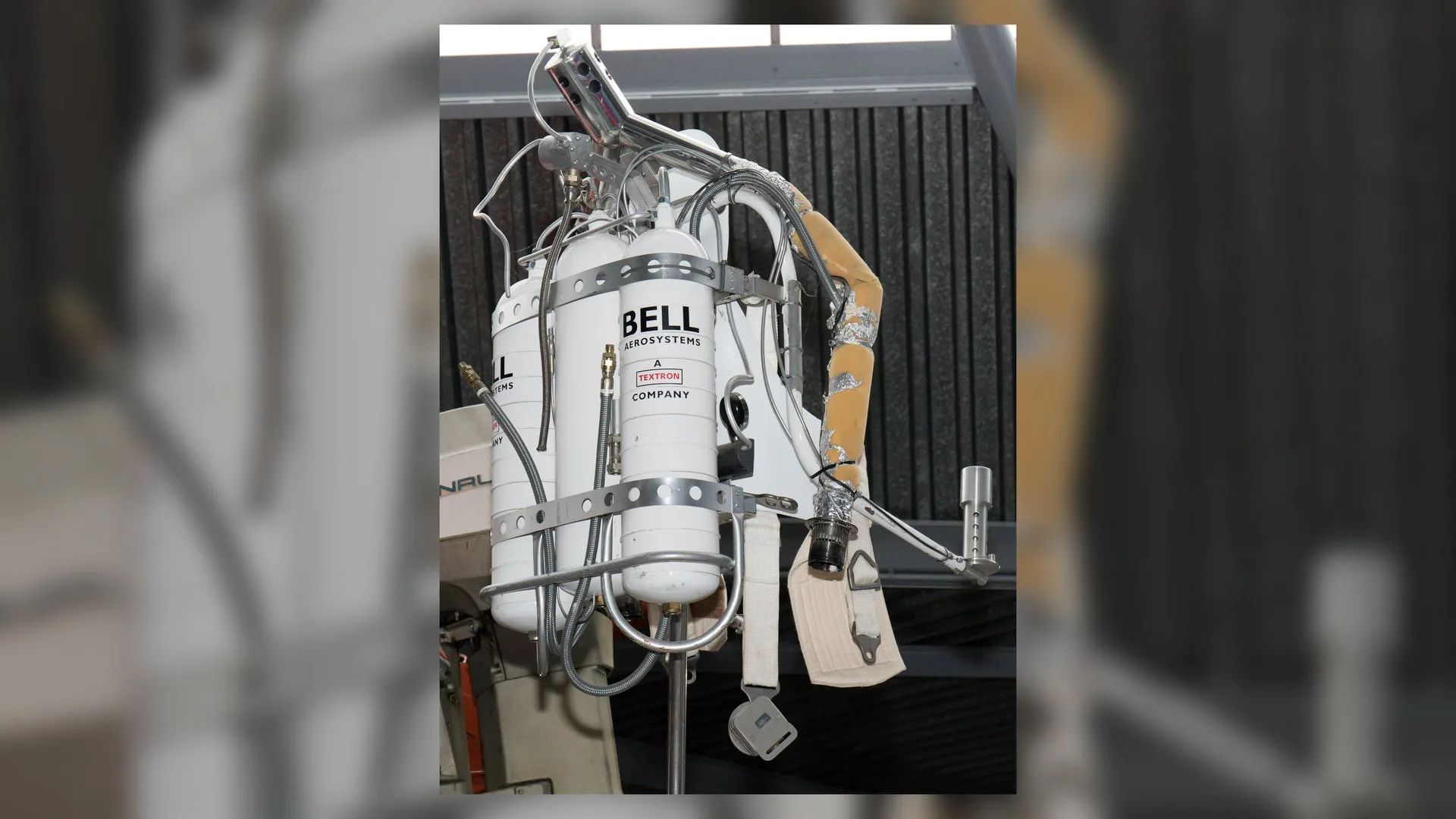
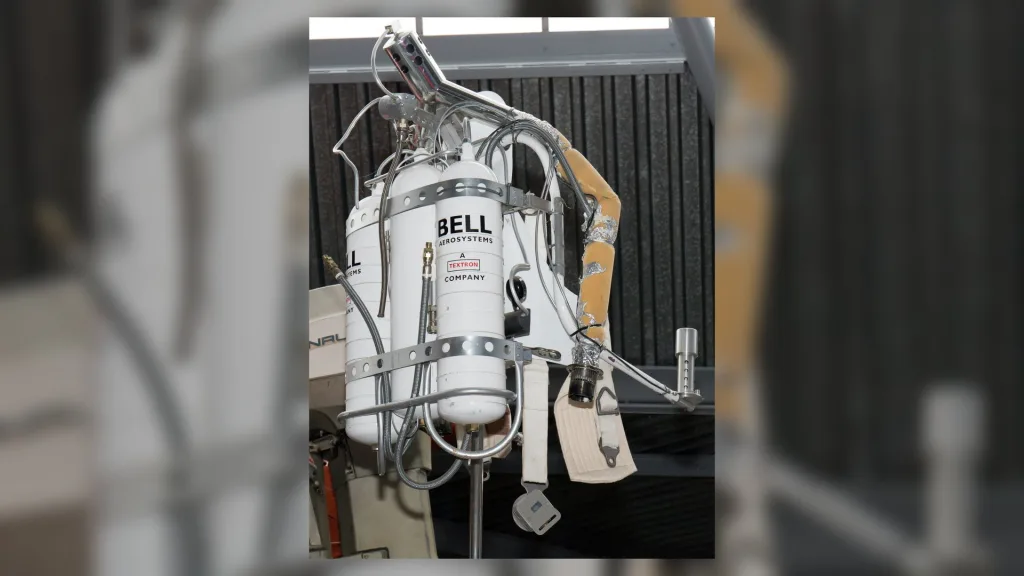
The device in most of that footage is the Bell Rocket Belt, developed by Bell Aerosystems with U.S. Army funding. Its first free flight, by engineer Harold Graham, took place in April 1961. It did not burn jet fuel. It used hydrogen peroxide, forced over a catalyst so that it decomposed into a jet of superheated steam. That was simple and powerful, but the fuel ran out fast. A full tank gave roughly 20 to 30 seconds of flight.
The Army concluded the belt was impractical for soldiers. It became a showpiece instead, appearing in the James Bond film Thunderball (1965) and at the opening ceremony of the 1984 Los Angeles Olympics.
Why not the Moon?
Many people at the time imagined astronauts zipping around the Moon in jet packs. NASA studied flying platforms, but with no air and one-sixth of Earth’s gravity, the physics are tricky, and every kilogram of fuel had to be launched from Earth. Apollo astronauts drove a rover instead. The jet pack’s real space descendant is the backpack thruster astronauts have used for untethered spacewalks, starting with the Manned Maneuvering Unit in 1984.
The jet pack today
Personal flight has not disappeared. British inventor Richard Browning’s company Gravity Industries has built jet suits, with small turbines on the arms and back, that can fly for a few minutes and have been tested for search-and-rescue work in mountains. Other companies have built jet packs and flying platforms. All face the same old trade-offs: fuel, noise, cost and safety. The car, for now, is still winning the race.
Sources: Bell Rocket Belt, Wikipedia; Jet pack, Wikipedia; Manned Maneuvering Unit, Wikipedia; Gravity Industries.