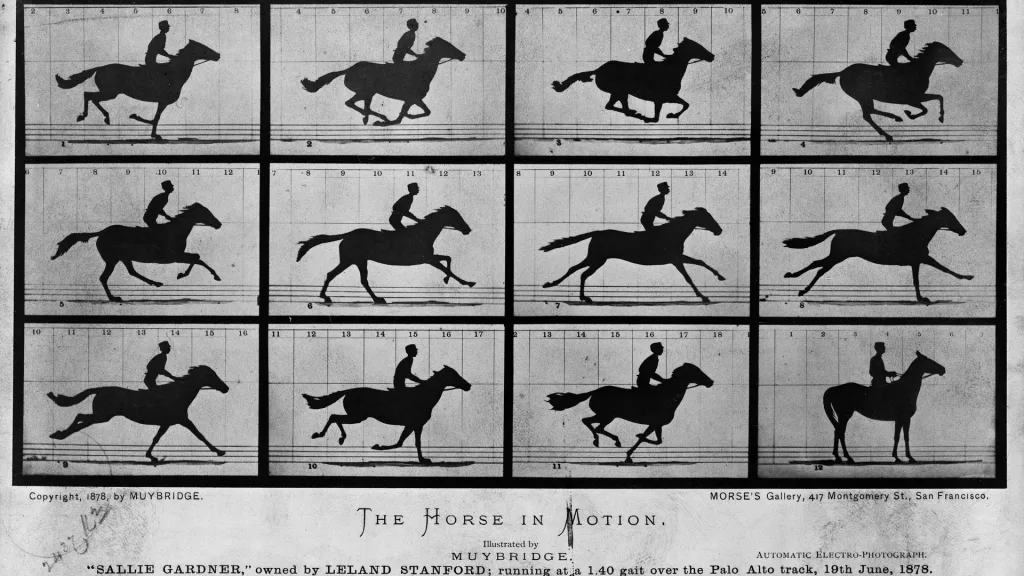
Does a running horse ever have all four hooves off the ground at once? In the 1870s, nobody could say for sure. A horse’s legs move too fast for the human eye, and painters had guessed for centuries, often showing horses with legs stretched front and back like a rocking horse.
Stanford’s question
Leland Stanford, the railroad magnate and former governor of California, was a horse breeder with a keen interest in the question. He hired Eadweard Muybridge, an English-born photographer known for dramatic landscapes of Yosemite, to settle it. Early attempts in 1872 and 1873 were inconclusive, as cameras were too slow.
Twelve cameras in a row
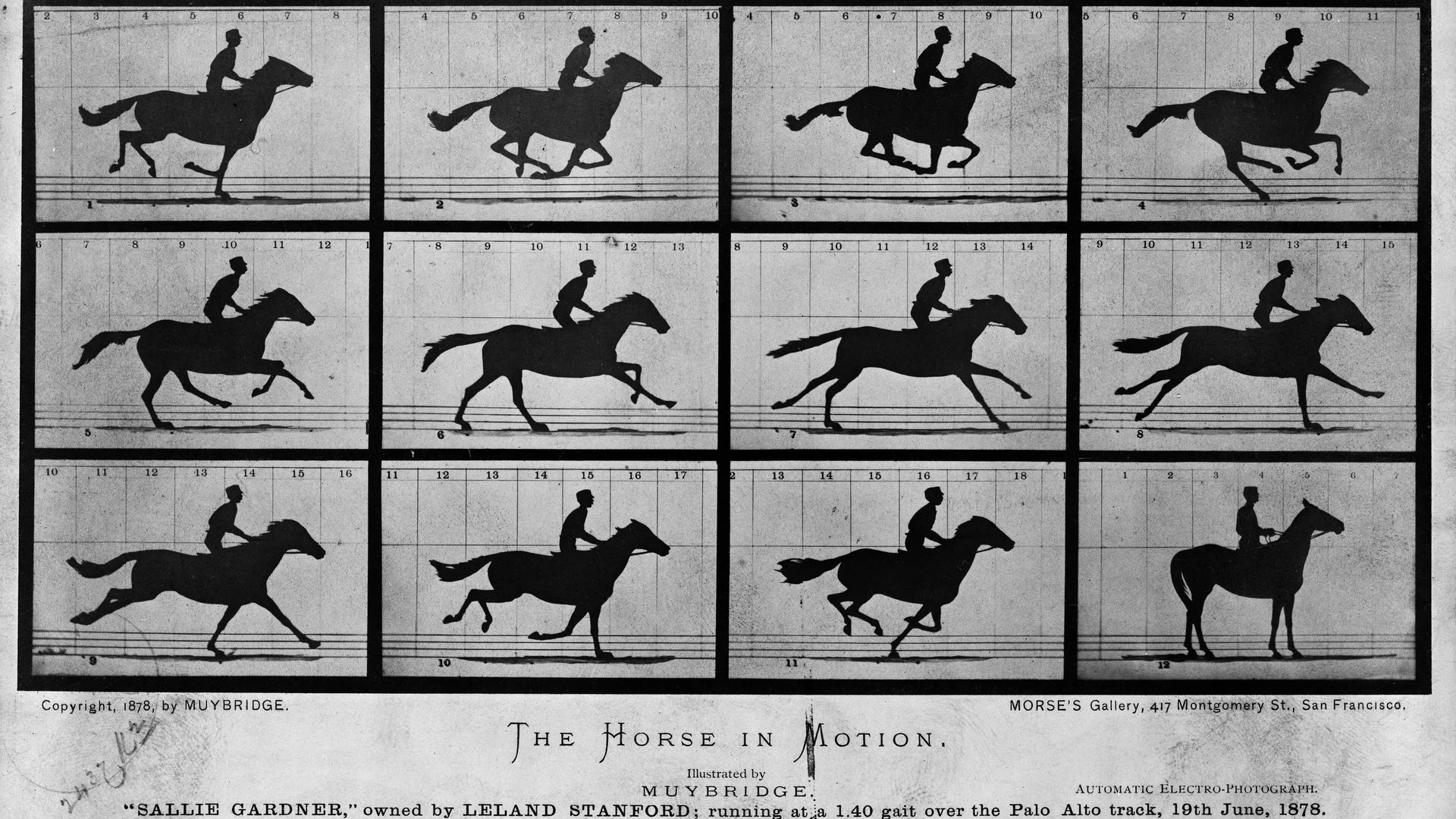
In June 1878, at Stanford’s farm in Palo Alto, Muybridge set up a row of cameras along a track, each triggered in sequence as the horse passed. The result, a series of photographs of the mare Sallie Gardner at a gallop, showed clearly that all four hooves were off the ground at one moment, though not with legs stretched out. They were tucked underneath the body. The painters had been wrong.
The images were published as “The Horse in Motion” and caused a sensation. Muybridge then built a device he called the zoopraxiscope, which projected images from a spinning disc in rapid sequence, so audiences could watch the horse move. That was one of the first public demonstrations of motion pictures.
A complicated man
Muybridge’s life was as dramatic as his work. In 1874 he shot and killed his wife’s lover and was acquitted by a jury. He went on to photograph thousands of sequences of people and animals in motion at the University of Pennsylvania in the 1880s, a body of work still used by artists and animators.
From horses to Hollywood
Inventors including Thomas Edison and the Lumière brothers soon developed true motion-picture cameras, and movies arrived in the 1890s. Muybridge’s galloping horse is often called the ancestor of them all. Fittingly, the farm where it was filmed later became the campus of Stanford University.
Sources: The Horse in Motion, Wikipedia; Sallie Gardner at a Gallop, Wikipedia; Eadweard Muybridge, Wikipedia.